Greater global economic links are boosting some cities but hurting others. The government should target regeneration help on the hardest hit, says Dermot Finch
According to the government, Britain is "uniquely placed to succeed in the global economy". We're also "enthusiasts for globalisation", and global expansion is equated with "massive opportunity". We hear lots of positive rhetoric about globalisation benefiting the UK as a whole – which is spot on, at the national level. Look closer and there's a much more mixed picture from Reading to Bradford, from Milton Keynes to Stoke. UK cities have been feeling the effects of globalisation for decades. We've seen a move away from a manufacturing to a service-based economy. Belfast lost 26% of its manufacturing jobs during the 1960s and employment at the city's iconic shipbuilding giant, Harland and Wolff, has dropped from 20,000 in the 1950s to just 120 today. While Liverpool's population has shrunk by 16% since the early 1980s, Milton Keynes has struck gold – its numbers have increased to 78% as the city's retail and logistics sectors boomed. Some cities are just better placed than others to seize the opportunities of globalisation. With Reading's transport and trading links it's no surprise to hear that 40% of its workforce is employed in the top 20 exporting sectors, twice the proportion in Stoke and Doncaster. That's not to say that we're advocating a mass migration south (remember Policy Exchange's big splash last month with their Cities Unlimited report). Doncaster might not be growing at the same rate as Reading but that doesn't mean it can't flourish. I'd like to see more realism from cities about their niche in the world economy. Not every city and town can be world class. In global terms UK cities are small, but their unique selling point is that they are located closely together. Sheffield, Liverpool, Bradford, Leeds and a host of other cities are all within a 40 mile radius around Manchester - the equivalent to London's travel to work area. To compete on a global stage, cities and towns need to collaborate with each other – working together to promote brands like "Greater Manchester" or "Greater Birmingham". Politicians cannot and should not reverse the tide of global economic change but they can be more up front about it. Gordon Brown acknowledged in his foreword to autumn's Labour Party conference paper that economic restructuring, driven by globalisation has meant reduced security for lower skilled workers. The next step is to focus regeneration spending in cities on those hardest hit – by reskilling those whose jobs have disappeared as a result of offshoring or industrial decline. Let's look beyond fancy new city centre buildings and address some of the challenges globalisation presents for UK cities.
· Dermot Finch is the director of policy research unit Centre for Cities. Their report, UK Cities in the Global Economy, is available for download at centreforcities.org/globalisation
North of the divide, people earn less, die at least a year earlier on average and get a worse education for their children
Jonathan Leake and Kevin DowlingPublished: 15 August 2010
The north-south divide, Britain’s traditional social and economic barrier, is getting more stark — and it may be creeping further south.
Researchers have drawn the divide as a clear diagonal line bisecting the country from Gloucester, just south of the line, to Grimsby, at its northeastern end.
Analysis of data including average incomes, house prices, life expectancy and levels of education shows that the gap between the two regions has grown wider in the recession.
It had been expected that the banking crisis, with its devastating effect on the financial services industry, which is mostly concentrated in London and the southeast, would narrow regional differences.
Instead the government bailouts of banks — valued by some at £1.3 trillion — have greatly benefited the south as the money has trickled out into the wider economy.
G20 summit protesters have clashed with police after crowds flooded into central London as world leaders prepare to discuss the global economic meltdown.
Tens of thousands of people have marched through London demanding action on poverty, climate change and jobs, ahead of next week's G20 summit.
The Put People First alliance of 150 charities and unions walked from Embankment to Hyde Park for a rally.
Speakers called on G20 leaders to pursue a new kind of global justice.
Police estimate 35,000 marchers took part in the event. Its organisers say people wanted the chance to air their views peacefully.
Protesters described a "carnival-like atmosphere" with brass bands, piercing whistles and stereos blasting music as the slow-paced procession weaved through the streets.
Police said one man was arrested during the march for being drunk and disorderly.
Image caption For advanced economies manufacturing tends to become less important
A new study from the Brookings Institution argues that American prosperity is being driven by advanced industries. It raises the question as to whether de-industrialisation can be reversed.
It's a refrain that has been heard frequently in the US and the UK after the financial crisis: there's a desire to rebalance the economy away from banking and towards making things once again.
Made in America, Made in Britain, Designed in Britain are among the phrases heard from governments and businesses after the worst recession in a century.
De-industrialisation is when industry counts for less than services in the economy. When countries grow, they tend to industrialise, so they move out of agriculture and into manufacturing, which has higher productivity and wages.
Industrialisation, and indeed the Industrial Revolution, is how countries become middle class, and some become rich.
Inequality
But, for advanced economies, manufacturing starts to become less important as a share of output once they become prosperous. Business services, retail, and finance start to dominate, and workers move out of factories and into offices or stores.
This process is associated with a loss of good, blue collar jobs, increased inequality, and less innovation since most research goes into industrial production.
But, reversing de-industrialisation is challenging. Emerging economies like China can produce more cheaply and information and communications technology (ICT) has lowered the costs of logistics, so that globalisation makes it harder for rich nations to compete with lower cost producers.
In fact, Dani Rodrik of Harvard points to pre-mature de-industrialisation for some developing countries which are moving from agriculture to services, which holds worrying consequences for countries that have yet to gain a firm foothold in the middle income strata.
Recovery
So, can it be done?
According to the Brookings Institution, advanced industries - hi-tech manufacturing and skilled services - where one fifth of employees have STEM - science, technology, engineering and maths skills - have led the US recovery.
Advanced industries have grown 30% faster than GDP since 1980. Since the 2009 recession, they have added one million jobs. Even more remarkably, advanced services have created almost two thirds of all of the new jobs during the recovery.
In an era of slow wage growth, advanced industries also report earnings growth that is five times faster than the average for the US.
And they are a fast-growing part of the economy. Adding $2.7 trillion to GDP, advanced industries are the biggest part of the American economy, accounting for 17% of GDP - that's more than finance, health care, or real estate. These industries account for approximately one quarter of all US employment. Image caption Staying in the US makes more sense for manufacturers thanks to a raft of falling costs
Automation
But, manufacturing jobs are still about two million below their 2007 levels, according to the Information Technology and Innovation Foundation, and they attribute the resurgence to a rebound from the depths of the recession.
That was echoed by Matt Murray, director of the Center for Business and Economic Research at the University of Tennessee. He forecasts that manufacturing jobs will decline after 2017 and return to the long-term, downward trend. It's because of overseas competition but it is also due to automation, so that more output can be made with fewer workers.
That's consistent with the long-term trend where American industrial output has increased with some ups and downs since 1950 in absolute terms, but has shrunk as a share of GDP since services has grown relatively more quickly.
After all, the United States is the second largest manufacturer in the world with about $2trn in annual output, only losing its crown to China a few years ago.
But, manufacturing jobs have declined since 1980. After rising from 13 million in 1950 to peak at nearly 20 million in 1980, 2010 saw a drop to a historic low of about 11.5 million. So, the impressive rebound since then still takes employment to around 12.3 million, which is the lowest in the post-war period, lower than in 1950.
Growth
It's a similar pattern in the UK. Around 2.6 million people work in manufacturing, a figure that has halved since the late 1970s. Now, manufacturing accounts for 8% of jobs, down from a quarter of all jobs in 1978.
Manufacturing accounts for about 10% of national output, having dropped by about one third in the late 1970s. But, like the US, British manufacturing has grown in in absolute size over the past few decades.
Although hard hit in the last recession, Britain is still the seventh largest manufacturer in the world and the bulk of R&D spending, more than 70%, goes into the sector.
Compared with its share of GDP, manufacturing makes an outsized contribution to exports, accounting for nearly half of British exports. The UK still imports more manufactured goods than it exports, so there is a trade deficit.
But, the industries that sell overseas are also in advanced sectors, so technology, R&D and STEM workers constitute the new face of manufacturing too.
But, unlike the US, there hasn't been a rebound in manufacturing jobs in high-tech sectors like chemicals, pharmaceuticals, or automobiles. Only the aerospace industry has had some job growth since 2007.
Also, labour productivity, that is output per worker, is low. Britain ranks above the world average, but lags other countries like the US as well as Germany.
Middle class
I've written before about the lack of STEM workers being an impediment for UK employers who believe that it could be a brake on economic growth.
Plus, there are other favourable factors that have boosted US manufacturing such as the shale energy revolution that have lowered costs. So, even if wages in the US are higher than emerging markets, for car companies where labour costs are only 10% of the total, other costs falling in America makes re-shoring or bringing production back to the US look appealing. Besides, wages are rising in not just China but also other emerging economies that have joined the middle class in droves.
So, is it possible to reverse the trend of de-industrialisation?
Even if output grows, employment will likely face pressure from robotics and technology.
Plus, even with the resurgence in the US, manufacturing is unlikely to become the biggest part of the economy.
But, economic growth can be boosted by new engines, such as advanced industries.
There are signs that it is happening in the US. And there are lessons for Britain and other advanced economies looking to re-balance their drivers of economic growth.
Manufacturing contributes £6.7tr to the global economy. Contrary to common belief, UK manufacturing is strong with the UK currently the 11th largest manufacturing nation in the world. Manufacturing makes up 11% of UK GVA and 54% of UK exports and directly employs 2.6 million people.
Despite the decline since the 1970s, when manufacturing contributed 25% of UK GDP, the UK ranks second globally in aerospace manufacturing. In the half-year from January to June 2014, the UK-based car industry had its best year in new car sales in 9 years.
1.28 million new cars were sold during the period, a rise of 10% compared to the same period in 2013. While the chemical and pharmaceutical industries add £20m per day to the UK balance of trade. Underpinning these important statistics is an average annual productivity increase of 3.6% – two and a half times greater than the UK economy as a whole.
While the contribution of manufacturing to GDP has declined on paper, many of the services provided to manufacturers which would have once been considered part of manufacturing, such as catering, cleaning, building services, security etc, are now allocated into different areas of the economy. However, those contributions are directly reliant on manufacturing for continued business and could actually be considered as a part of manufacturing’s GDP input.
Rank
Country/Region
(Millions of $US)
Year
World
11,185,841
2011
1
China
2,330,684
2011
European Union
2,312,723
2013
2
United States
1,800,500
2011
Eurozone
1,793,895
2013
3
Japan
1,073,277
2012
4
Germany
710,951
2013
5
South Korea
370,393
2013
6
Italy
284,477
2013
7
Russia
266,692
2013
8
Brazil
250,149
2013
9
France
249,074
2013
10
India
223,138
2013
11
United Kingdom
219,036
2013
12
Mexico
215,689
2013
13
Indonesia
205,768
2013
14
Canada
169,120
2008
15
Spain
166,142
2013
16
Thailand
127,569
2013
17
Turkey
125,598
2013
18
Switzerland
113,481
2012
19
Australia
104,056
2013
20
Netherlands
91,602
2013
Countries by Manufacturing output using the most recent known data thanks to The World Bank and Wikipedia.
UK Balance of Trade
UK Manufacturing 2014 – The Facts
Every two years manufacturers’ organisation EEF publishes a fact card covering manufacturing GVA, employment, the % of manufacturing in the region’s economies, Britain’s place in the global manufacturing league table, R&D spending and more. EEF (The Manufacturers’ Organisation) Manufacturing Facts and Figures
Statistics by Sector
British Aerospace Industry
Beth Pickering, Airbus in the UK, Broughton
100,000+ direct jobs in UK Aerospace
ADS has over 850 members (from SMEs to globals)
Annual earnings = £24.2bn
Revenue: £12.4bn
75% of turnover to export markets
17% global market share
British Automotive Industry
A worker at the Jaguar Land Rover plant helps put together a Range Rover Evoque.
More than 550 UK members of SMMT
£6bn investment in past two years
2.6 million cars registered in the UK 2013
Two out of the top 10 selling cars for 2013, the Vauxhall Astra (4th) and the Nissan Qashqai (6th), are made in the UK, while the Ford Fiesta was the UK’s best selling car.
1.58m vehicles (81% exported) and 2.5m engines (62% exported) made in the UK last year
2,350 automotive suppliers in UK, employing 82,000 people
Typically £55bn annual turnover
£27bn revenue in 2011
720,000 employed across automotive industry, 140,000 directly employed in manufacturing
More than 75,000 young people employed as apprentices over the last 5 years. 18,000 in automotive retail at any one time
British Chemical Industry
The Baker Hughes Eco-Centre facility can process in excess of 30,000 tonnes (33,000 tons) of drill cuttings and 14,000 cubic meters (3.7 million gallons) of liquid waste, or slops, annually.
£60bn revenue in 2012
600,000 people are currently employed in the industry
Represents 15% of UK manufacturing GVA
Has an average employee cost of £42,000 per head
Added £20m to the UK balance of trade every day for the last twenty years
Spiral Construction are the UK’s leading manufacturer of spiral and helical staircases and have been nominated by Andrew George, Liberal Democrat MP for St Ives
1 in 14 of the UK workforce is employed in construction – nearly 2 million people
Provides 88,000 new job opportunities yearly
Employs just under 200,000 women in the sector
More than 35% of construction employees run their own companies
More than a quarter of employers have recruited a school leaver in the last 2-3 years
Nearly 50% of employers in the building services engineering industry take part in the modern apprenticeship scheme
British Defence Industry
BAE Systems Ambush submarine.
£35bn annual UK turnover
The UK is the world’s second biggest defence exporter behind the US
Employs 300,000 overall in the UK
9,000 defence companies including small businesses exist in the UK
BAE Systems – the UK’s largest defence company – currently employs 40,000 domestically
10% of UK manufacturing is made up by defence
British Electronics Industry
A British firm has made the world’s largest all-electric pipe bender.
Worth £78bn a year
Is the world’s fifth largest in terms of production
Employs over 850,000 people
This makes up 2.9% of the UK’s workforce
In semiconductors, almost 80% of the activity comes from foreign direct investment
The UK is home to 40% of Europe’s semiconductor design houses
British Food & Drink Industry
Cadbury Fingers in production.
Turnover of £76bn in 2012, the UK’s largest manufacturing sector
Accounts for 15% of all UK manufacturing GVA
Employs 400,000 workers domestically, 15% of manufacturing workforce
Exports over £12bn of food and non-alcoholic drink products a year, 77% of which go to the EU
Invested over £1bn in to R&D in 2011, resulting in over 8,500 new products
Businesses have reduced rate of injuries by over 50% over the last 20 years
A brief analysis of the UK's trade and foreign direct investment relationship with the EU
How large is the EU Economy?
Since its formation in 1993, the European Union1 (EU) has become larger than any individual economy in the world, with its GDP surpassing the USA’s in 2003, for the first time since 1998, as shown in Figure 1. Despite this, the EU’s share of global GDP has fallen from 30% in 1993 to 24% in 2013. This is because growth in non-EU economies has outpaced growth of EU economies, mainly driven by strong growth in the BRIC (Brazil, Russia, India and China) economies.
How important is the EU to UK trade?
The UK has traditionally had strong trade links with the EU. Despite changes in the composition of the global economy, the EU in 2014 accounted for 44.6% of UK exports of goods and services, and 53.2% of UK imports of goods and services. However, strong economic growth in many developing economies outside the EU has resulted in non-EU economies growing in importance to UK trade, with the proportion accounted for by the EU falling consistently since 1999, despite the value of EU trade increasing. Exports from the UK to EU and non-EU countries have grown on average by 3.6% and 6.5% respectively in each year between 1999 and 2014. However, the stronger export growth to non-EU countries has resulted in the proportion of UK exports destined for the EU falling from 54.8% in 1999 to 44.6% in 2014. Growth in the value of UK imports of goods and services from EU and non-EU countries is more comparable, growing on average by 4.7% and 5.5% respectively in each year since 1999. Faster growth in the value of UK imports compared to exports with the EU has resulted in the UK’s overall trade balance with the EU deteriorating (value of imports exceeding exports), with the trade deficit widening notably, reaching £61.6 billion in 2014 compared with £11.2 billion in 1999, as shown by the black dotted line in Figure 2. UK trade with the EU is dominated by goods rather than services; in 2014, trade in goods represented close to two-thirds of all UK exports to the EU, and over three-quarters of total UK imports from the EU. Between 1999 and 2014, goods imported by the UK from the EU have risen by 4.9% per year on average, compared to exports which have risen by 2.5% per year, causing the UK’s trade in goods deficit with the EU to rise to £77.0 billion. Although the UK has historically recorded a trade in goods deficit with the EU, its trade in services balance with the EU is much more favourable, running a surplus in each year since 2005, which reached £15.4 billion in 2014. UK exports of goods and services to non-EU countries have grown at a faster rate than imports, driven largely by services exports. This has resulted in the UK running an overall trade surplus with non-EU countries (value of exports exceeds imports) over the past three years, which reached £27.8 billion in 2014, as shown by the grey dotted line in Figure 2.
How important is the EU to UK foreign direct investment?
Between 2004 and 2013, the net stock of assets held by UK residents and businesses overseas grew by an average of 5.4% per annum, but this was outpaced by growth in the net stock of assets held by overseas residents and businesses in the UK, which rose by an average of 11.6% per annum. This resulted in the UK’s net position with the world – that is, UK net assets held overseas minus net overseas assets held in the UK – declining by an average of 15.9% per annum over the same period.
In to their respective pre-downturn peaks. More recently, EU earnings have risen since 2012 and surpassed their pre-downturn peak in 2013.
The British Parliament has been in existence since 1215, when King John signed the Magna Carta, and is one of the oldest in the world. The workings of it have changed through the ages and below is a brief description of the ways in which it works. Parliament consists of two chambers, the House of Commons, consisting of members of parliament who are elected, and the House of Lords, consisting of unelected peers. The Sovereign, at the moment Queen Elizabeth II, is the third part of the Parliament. The government is officially known as Her Majesty's Government. The Queen has, in principle, a lot of power over the government, but chooses not to exercise that power. This position has emerged through the ages, though at one time the Sovereign exercised a lot of power over the government, and the country.
The Make Up of the House of Commons Members of Parliament The House of Commons consists of Members of Parliament, who are elected. The United Kingdom1is split into constituencies, and each constituency votes for an MP (Member of Parliament) to represent them, using the 'first past the post' system. Each MP is a member of one of the political parties, or an independent candidate, and this is stated on the ballot paper. There is no requirement to be a member of one of the parties, but most MPs are party members.
Elections
At least every five years there is a general election, when the MPs are elected. The Prime Minister decides on the timing of the election, and can call an election at any time, but one must be called within five years of the one before. It is usual for an election to be called after four years. A motion of no confidence can be brought against a government, which, if successful, will result in an early general election. They are rare however, and are likely to bolster support for the government if it fights off such a challenge. There is potential for a by-election where one constituency has to elect a new MP. This happens if the MP cannot serve as MP, such as if they die, resign2, or become a member of the House of Lords3. This allows a new MP to be elected.
The Governemnt
At least every five years there is a general election, when the MPs are elected. The Prime Minister decides on the timing of the election, and can call an election at any time, but one must be called within five years of the one before. It is usual for an election to be called after four years. A motion of no confidence can be brought against a government, which, if successful, will result in an early general election. They are rare however, and are likely to bolster support for the government if it fights off such a challenge. There is potential for a by-election where one constituency has to elect a new MP. This happens if the MP cannot serve as MP, such as if they die, resign2, or become a member of the House of Lords3. This allows a new MP to be elected.
The opposition
The official opposition has few privileges attached to it, but usually the opposition has a greater voice in speaking out against the government, and the media will pay more attention to the opposition than more minor parties. There is very little that the opposition can do that other parties cannot, but the opposition having more MPs has more power to oppose laws, especially if the government is divided over an issue. It can also use this power to help it dictate the business of the House.
The Cabinet
The Cabinet are the main people who run the country, with the Prime Minister in charge, and other ministers having their own department or ministry. They are each responsible for some area of public policy such as education, health and transport. A minister has some freedom in the decisions (s)he can make, but in some cases legislation is needed, which requires the support of both houses of Parliament (see 'The Passing of Laws' below) Ministers are chosen by the Prime Minister, and are usually chosen from the government party. Most cabinet posts need to be held by MPs. Some minor posts can be held by members of the House of Lords, but only MPs can debate issues in the House of Commons, so it would be unlikely for someone not an MP to have a high profile role in the government, as they would not be able to defend their position in the House of Commons.
The Parties
Most parties give their leader, and other important party members, a safe seat4 to represent. It would be a political embarrassment if the party leader, or high-profile members of a party ,were to be elected out of office. In the case of a cabinet minister, they could not serve as minister until, and unless, they are re-elected. It is possible for a member of a political party to stand for election in any constituency, but they could be expelled from a party for standing against one of their fellow party members, and this is not usually in the interests of either, as they could split the vote, and allow another party in.
The Make Up of the House of Lords
The House of Lords consists of both hereditary peers, who have inherited their peerage and their title, and life peers, who are appointed by the government, and stay in their positions for life. A large majority of the peers are life peers. Also, important members of the clergy form part of the House of Lords, as do senior judges, or law lords, and other office holders, who have specific roles in the House. Only the office holders, such as the Leader of the House, are paid, the rest can only claim expenses. Members of the House of Lords cannot become MPs, or hold certain other elected posts. However, lords are allowed to disclaim their title and when standing to become MP, for example, and reclaim the title later. The rule is, however, that no-one can be a member of both houses at the same time. Peers may have some loyalty to some political party, but there is less of a compulsion to follow the wishes of any party, than for MPs. They cannot be expelled from the House of Lords by being voted out, so have less need for the support of a party, although peers may feel some loyalty to one party. At the time of writing, the government is reforming the House of Lords, and has appointed so called people's peers, who are not chosen for their affiliation to any political party, but are, in theory, appointed on merit, by an independent committee. This has not met with much success, as the people chosen were not ordinary members of the public. It may be that the House of Lords becomes fully elected, but it is unlikely to be the priority for any government, and slow progress is likely on this issue.
The Passing of Laws in the House of Commons
Almost all laws that are made are proposed by the Cabinet. The Cabinet, through a relevant minister, proposes laws to the House of Commons, and then there is a debate on the issues. The bills5, go through a number of stages in the House of Commons. First, the bill is announced in brief. This is called the first reading. Within a fortnight, the principles and some of the detail of the bill are announced, and they are debated. This is the second reading. Here, there is a vote, and if the bill is not supported, then it cannot proceed further. Assuming a vote is successful, then it is passed on to the committee stage. At the committee stage, the bill is discussed in minute detail. A committee is a number of MPs meeting to discuss the bill. Sometimes a standing committee is set up to discuss the bill. Sometimes, a select committee, dealing with a certain area of government may discuss the bill. On very important matters, the committee may consist of the whole House of Commons or both houses of parliament. After this stage, the committee report back to the House of Commons. Amendments to the bill can be proposed at this stage. The individual details of the bill cannot be discussed, however. This precedes the third reading, where the bill with any amendments is announced to the House of Commons. If the House approves, then the bill is passed to the House of Lords.
In the House of Lords
The House of Lords will then debate the issues, following similar stages to those the bill must pass through in the House of Commons, although it is not usual for committees to be discuss bills, rather it is more likely for the whole house to act as a committee. After this stage, both houses must agree on the final form of the bill, so if the bill has been amended, the assent of the House of Commons is needed for the amended bill. If both houses accept the bill then it, possibly having been amended, will go to the Queen to sign it. The Sovereign is unlikely to decline this, and the last time the Royal Assent, as this is known, was refused was in 1707. At one time, the Sovereign would have used his/her power a lot more, but more recently the Sovereign has deferred to parliament. Mostly government bills are passed as stated, with few changes as the government will almost always have a majority, so can usually force through bills, if the government's MPs vote with the government. The greater the majority, the easier this is. Most parties have individuals in them called Whips who have a role of keeping their party's members informed of parliamentary business, and also try to make sure that the MPs vote in favour of their party. In a coalition government the situation is different, as the two parties may disagree on many issues.
Raising bills in the House of Lords
Some bills are debated solely in the House of Lords. These tends to be noncontroversial bills, where the main problems are to do with the detail, rather than the principle. These bills must still be presented to the House of Commons, who must vote in favour of it, for it to become law. Also bills relating to the introduction of new charges, such as taxes, must be raised by a government minister in the House of Commons.
Overruling the House of Lords
The House of Lords usually follows the Salisbury Convention in that parts of a government's manifesto are not challenged in the House of Lords. Also, the system allows for the House of Lords to be overruled. Bills dealing only with tax or government spending must be made law within one month, for example. Also after one year, and in a new session of parliament, a bill rejected by the House of Lords can be sent for Royal Assent, bypassing the House of Lords. There are some types of bills that must have the support of the House of Lords to become law.
Private Members Bills
Any MP can propose a bill, called a private members bill. These are unlikely to be made law, but can be. They tend to be proposed where the government does not want to raise it, and they generally do not have government backing, so are rarely made law, and may not even be fully debated. The process is sometimes used to highlight the need for government action rather than to make law. The Early Day Motion system can be a way of highlighting the need for action. They take the form of a request 'That... ' followed by the subject of the motion. While they may not be debated, they are distributed to MPs so can become widely known in the House of Commons. Some Early Day Motions are comments on certain groups, actions, or events, while some seek to encourage certain actions by the House of Commons. The motions can be endorsed by other MPs, by signing them, and amendments can be made, by the MPs, and the amended motion may be signed. This system can give an indicator of the views of the MPs, and is also used to raise issues when there is little or no time to debate them. They, in themselves, may not become law, although they can, but can be a way of drawing attention to the need for law to be made, or action taken in the case in question. There is limited time for debate of bills in the House of Commons, so private members bills are presented to the MPs, and some of these are voted for. The successful bills are then given time for debate, and have a chance of becoming law, given support of the MPs. Also, the ten-minute rule allows for a short speech in favour of a bill, and a short speech against it. This can be an attempt at law, but may be an attempt to highlight an area of concern. The time for this bill is when the House will usually be full, and the press are likely to be present, and the MP in question is likely to be able to get a lot of publicity, even if the bill does not make law.
Devolution
In the last few years, the government has devolved some power over Scotland, Wales and Northern Ireland to parliaments in these countries, called respectively the Scottish Parliament, the Welsh Assembly, and the Northern Ireland Assembly. This allows them some power over issues only affecting their country. At the moment, the Welsh Assembly, Scottish Parliament, and the Northern Ireland Assembly, allow these countries to have more control over certain issues in their countries. Wales and Scotland, and Northern Ireland still have MPs in the British parliament. This is a source of controversy, as Scottish, Welsh and Northern Irish MPs can vote in issues that only affect England, but not the other way round.
Conclusion
The British Parliament is currently changing in a number of ways. However, this entry is meant to give a guide to the system at the current moment. For other information about the Parliament, and the devolved governments, the following Links might be useful. They are links to the official websites of the parliaments.
Since 1998, U.K. runs consistent trade deficit mainly due to increase in demand of consumer goods, decline in manufacturing and deterioration in oil and gas production. In recent years, U.K. has run the biggest trade deficits with Norway, Germany, China, Hong Kong and Netherlands. September 17, 2014. Source: http://www.tradingeconomics.com/united-kingdom/balance-of-trade
The government says it wants to make the immigration system tougher, so what is in the plans being considered by Parliament and why the current concern over the issue?
What does the government want to do about immigration? Net migration - the difference between those coming in and leaving the UK each year - rose under Labour to more than 200,000 a year. The coalition says that, by the next election in 2015, the total should be "tens of thousands", rather than hundreds of thousands. The government is also promising to clamp down on illegal immigration - not included in the official figures - and benefit claims. Why is immigration such a big political issue? There have been concerns over pressure on services such as education and schools, while many workers say their wages are being driven down by foreign employees. Difficulties deporting foreign criminals have created unwelcome headlines too. The rise of the UK Independence Party, which campaigns for cuts to immigration, has further heightened interest in the issue at Westminster. What's in the Immigration Bill? It compels landlords to check whether tenants are in the UK illegally, with those failing to do so facing large fines. Banks will have to check immigrants' legal status before offering accounts. Some temporary migrants - such as students - will pay a £200-a-year levy towards the cost of NHS services. And registrars will have to inform the Home Office of planned weddings between and UK citizens those from outside Europe, to cut down on "sham" marriages. What about deportations? The bill says foreign criminals can be deported even before the outcome of their appeal is known, as long as they do not face "serious irreversible harm" at home. The number of grounds for appeal against deportation is being reduced from 17 to four, which ministers say will simplify the system. Does Labour back the plans? Yes. At least the party says it will not oppose them in Parliament. But it also criticises the bill, saying it does nothing to tackle exploitation of workers, and the undercutting of UK citizens' wages. Labour is promising to "amend and reform" the legislation. Who opposes it then? Liberal Democrat deputy leader Simon Hughes has raised concerns that it is being rushed through. Housing groups are concerned about the onus on landlords to check tenants' status, and the British Medical Association warns that hospitals face a "bureaucratic nightmare" in levying the charges for NHS services. Some business groups say the changes could appear hostile to outsiders and might deter investment in the UK. Haven't there been immigration bills before? Yes, several over the past century, including, in recent years, changes such as English language tests, restrictions on the types of workers entering the country and longer periods of "naturalisation" through marriage. But critics insist the UK system is a "soft touch" and that more needs to be done to deter illegal immigrants and the exploitation of benefits and services. So, will the Immigration Bill become law soon? It looks set to get through the House of Commons with Labour's support, but could face more opposition in the Lords. The government wants it to come into action as soon as possible.
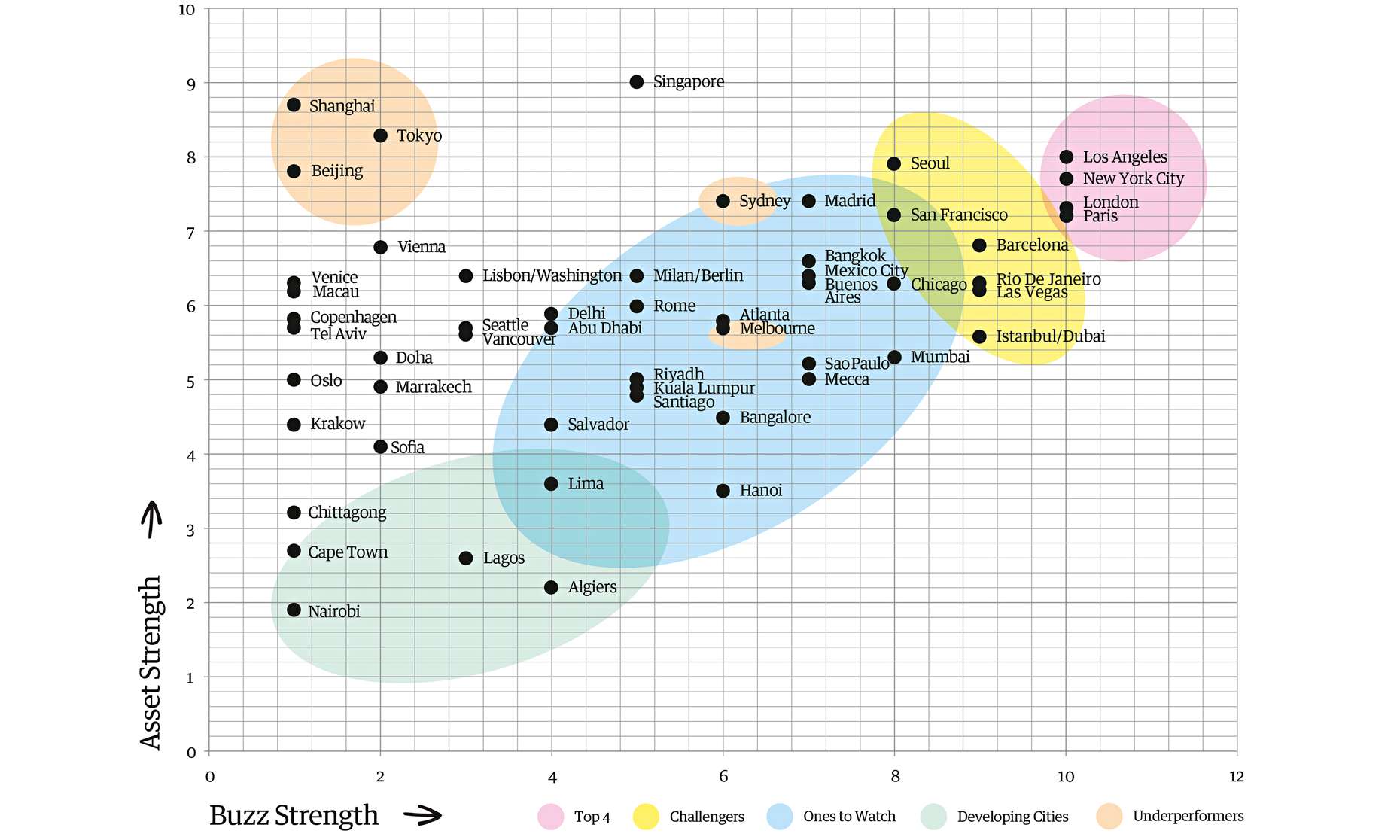
The first Guardian Cities global brand survey has thrown up a surprise winner (to us, anyway), plenty of surprise losers and some interesting ones to watch (Mumbai and Mecca, we're looking at you). Here's a breakdown of how the list was compiled
To establish our list of the world’s most powerful city brands, we asked Saffron, a brand consultancy that prides itself on its expertise in urban branding, to update its 2008 study of European cities into an assessment of 57 major cities around the world. The resulting "brand barometer" is eye-opening: did anyone expect LA to beat New York or London? Or Tokyo and Venice to fall so flat? The report measures two aspects of a city's brand: its “assets” – attractions, climate, infrastructure (particularly transport), safety and economic prosperity – and its “buzz”, a combination of social media (Facebook likes and Twitter sentiment analysis) and media mentions. Assets and buzz were each graded out of 10; the numbers were added to produce a total score. (Scroll down for an interactive bar chart of the final ranking.) Although the research was not limited to English language results, the use of social media sites popular among western countries must be taken into account when digesting the list. In China, Renren and Weibo are used rather than Facebook and Twitter, which may go some way to explaining the poor showing of Shanghai, for example. Tokyo scores a buzz of just 2, again due partly to Japan using its own social media engines – yet Seoul does remarkably well on the same criteria. “The western world is just not that in touch with the far east,” says Ian Stephens of Saffron. “Tokyo remains, for most people, an alien place for an alien experience. [Its brand] is underperforming relative to its assets. Whereas Seoul's and Singapore's offerings are on a more global basis: visitors are very pleasantly surprised at what they find there, it's less 'foreign' than they might have thought. "This brand list is all about how cities use their assets, how they do the best with what they have. Singapore, for example, is a transport hub and seems to be doing quite a lot with that basic thing.” Mumbai and Mecca are two more examples of up-and-comers in the brand stakes, while European cities – with the exception of London and Paris – struggle. Venice isn't the only loser, just the most surprising.“All the European cities do relatively poorly, perhaps because there are so many crammed up against each other,” says Stephens. On the whole, the results do show a clear correlation between asset strength and brand reputation. Cities hoping to buy themselves a bit of buzz should take this to heart. As Saffron founder Wally Olins, who died this month, liked to say: when it comes to brands, you can't just talk the talk, you have to walk the walk.
London beats
New York for second year running – but Asian cities will eclipse both in coming
decades, according to research
Booming stock markets and
global economic recovery continued the seemingly inexorable rise in the numbers
of the world's super-rich last year, according to a report that predicts their
ranks will swell by nearly 30% to 215,000 over the next decade. The world's so-called
"ultra high net worth individuals" – those with $30m (£21m) or more
in assets apart from their main home – number 167,669, according to a report from estate agents Knight Frank – up 59% over the past decade. Roughly equal to the
population of the London borough of Kensington and Chelsea –
and many of them do indeed have a place there – they control more than $20tn in
assets – more than the national output of the US and Germany put together. London was home to more
UHNWIs (4,224) than any other city in 2013 and this will still be the case a
decade later, with nearly 5,000 expected to be living there, according to the
report. Singapore and New York will leapfrog Tokyo and Hong Kong to
take second and third places. The top six cities have more UHNWIs living in them than
Latin America and the Middle East combined. Liam Bailey, global head of
research at Knight Frank, said the cluster of businesses, international appeal,
heritage and democratic institutions in London and New York are not easy to
replicate. But, he said, "London wins over New York: It's more diverse.
There are more nationalities living here and it's a more global city."
Which products does the UK export, and where does it export them to? Read on to find out!
Last week, figures from the automotive industry showed a decline in UK car sales. They also shone a light on the UK's third biggest export - eight out of 10 cars built in the UK are exported. HM Revenue and Customs releases monthly figures for UK trade. According to the latest figures from October 2011, the UK's biggest export in the year to date was nuclear reactors, boilers, machinery and mechanical appliances (including parts thereof). Mineral fuels, mineral oils and products of their distillation,bituminous substances and mineral waxes followed in second place, although incidentally it was also the most highly imported product in 2011 rising by 46% on the year. Vehicles other than railway or tramway rolling-stock, and parts and accessories thereof ranked as both third highest import and export. In the year to date (October 2011) the UK exported £23bn worth and spent £32bn on importing these items. The United States received the most British export goods last year, followed by Germany and France. The top trade partner for imports was Germany, followed by the United States and China. The UK exported £31.7bn worth of products to the US. Check out the tables below for top trading partners or download the spreadsheet for the full data on the UK's top exported and imported goods year on year.