Affichage des articles dont le libellé est London. Afficher tous les articles
Affichage des articles dont le libellé est London. Afficher tous les articles

08/05/2014
The world cities with the most powerful brands - get the data
from The Guardian online:
http://www.theguardian.com/cities/datablog/2014/may/06/world-cities-most-powerful-brands-get-the-data
The first Guardian Cities global brand survey has thrown up a surprise winner (to us, anyway), plenty of surprise losers and some interesting ones to watch (Mumbai and Mecca, we're looking at you). Here's a breakdown of how the list was compiled
• Sharon Zukin: Who is the frenzied image-control of city branding actually for?

To establish our list of the world’s most powerful city brands, we asked Saffron, a brand consultancy that prides itself on its expertise in urban branding, to update its 2008 study of European cities into an assessment of 57 major cities around the world. The resulting "brand barometer" is eye-opening: did anyone expect LA to beat New York or London? Or Tokyo and Venice to fall so flat?
The report measures two aspects of a city's brand: its “assets” – attractions, climate, infrastructure (particularly transport), safety and economic prosperity – and its “buzz”, a combination of social media (Facebook likes and Twitter sentiment analysis) and media mentions. Assets and buzz were each graded out of 10; the numbers were added to produce a total score. (Scroll down for an interactive bar chart of the final ranking.)
Although the research was not limited to English language results, the use of social media sites popular among western countries must be taken into account when digesting the list. In China, Renren and Weibo are used rather than Facebook and Twitter, which may go some way to explaining the poor showing of Shanghai, for example. Tokyo scores a buzz of just 2, again due partly to Japan using its own social media engines – yet Seoul does remarkably well on the same criteria.
“The western world is just not that in touch with the far east,” says Ian Stephens of Saffron. “Tokyo remains, for most people, an alien place for an alien experience. [Its brand] is underperforming relative to its assets. Whereas Seoul's and Singapore's offerings are on a more global basis: visitors are very pleasantly surprised at what they find there, it's less 'foreign' than they might have thought.
"This brand list is all about how cities use their assets, how they do the best with what they have. Singapore, for example, is a transport hub and seems to be doing quite a lot with that basic thing.”
Mumbai and Mecca are two more examples of up-and-comers in the brand stakes, while European cities – with the exception of London and Paris – struggle. Venice isn't the only loser, just the most surprising.“All the European cities do relatively poorly, perhaps because there are so many crammed up against each other,” says Stephens.
On the whole, the results do show a clear correlation between asset strength and brand reputation. Cities hoping to buy themselves a bit of buzz should take this to heart. As Saffron founder Wally Olins, who died this month, liked to say: when it comes to brands, you can't just talk the talk, you have to walk the walk.
http://www.theguardian.com/cities/datablog/2014/may/06/world-cities-most-powerful-brands-get-the-data
The first Guardian Cities global brand survey has thrown up a surprise winner (to us, anyway), plenty of surprise losers and some interesting ones to watch (Mumbai and Mecca, we're looking at you). Here's a breakdown of how the list was compiled
• Sharon Zukin: Who is the frenzied image-control of city branding actually for?
Guardian Cities global city brand barometer. Click here to view a larger image. Source: Saffron Brand Consultants
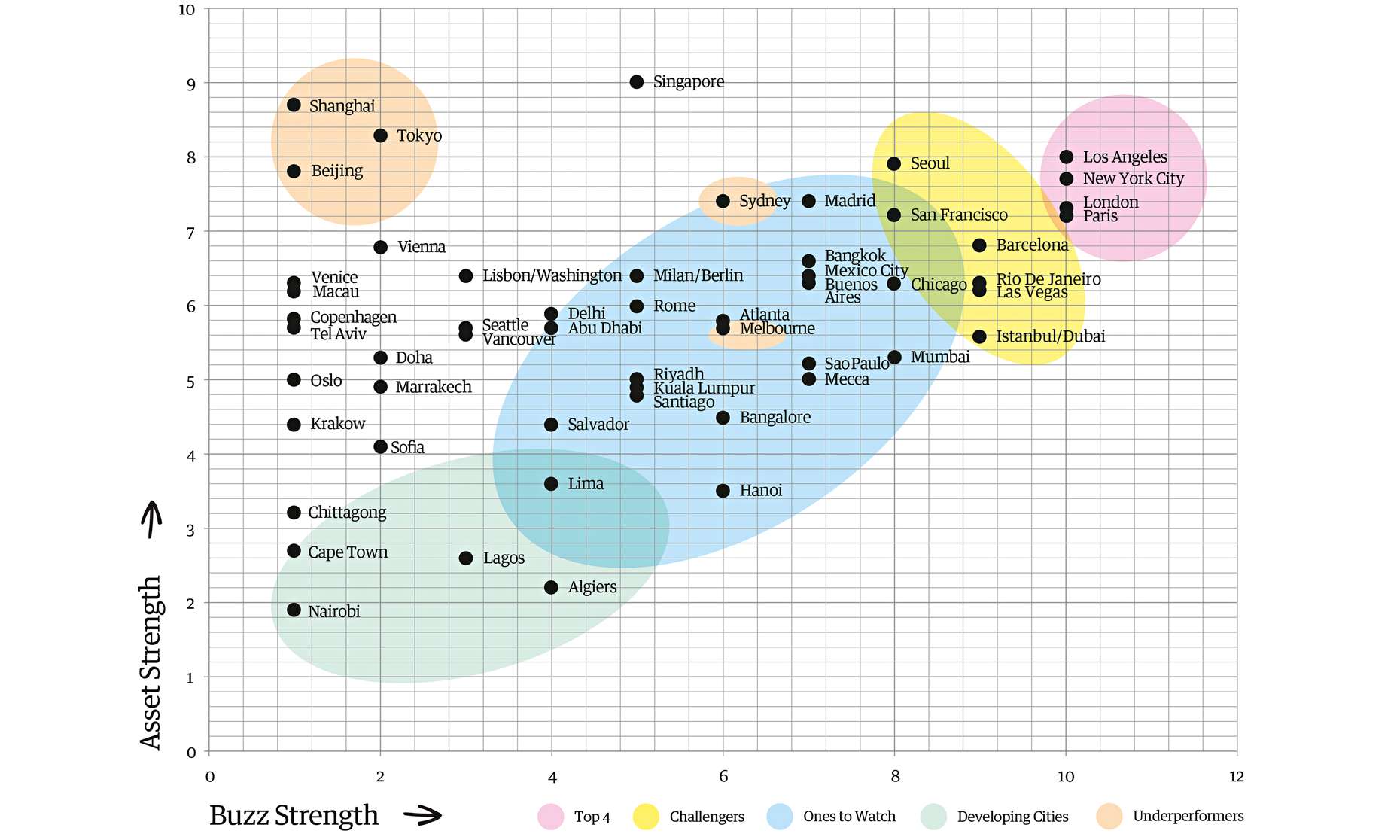
To establish our list of the world’s most powerful city brands, we asked Saffron, a brand consultancy that prides itself on its expertise in urban branding, to update its 2008 study of European cities into an assessment of 57 major cities around the world. The resulting "brand barometer" is eye-opening: did anyone expect LA to beat New York or London? Or Tokyo and Venice to fall so flat?
The report measures two aspects of a city's brand: its “assets” – attractions, climate, infrastructure (particularly transport), safety and economic prosperity – and its “buzz”, a combination of social media (Facebook likes and Twitter sentiment analysis) and media mentions. Assets and buzz were each graded out of 10; the numbers were added to produce a total score. (Scroll down for an interactive bar chart of the final ranking.)
Although the research was not limited to English language results, the use of social media sites popular among western countries must be taken into account when digesting the list. In China, Renren and Weibo are used rather than Facebook and Twitter, which may go some way to explaining the poor showing of Shanghai, for example. Tokyo scores a buzz of just 2, again due partly to Japan using its own social media engines – yet Seoul does remarkably well on the same criteria.
“The western world is just not that in touch with the far east,” says Ian Stephens of Saffron. “Tokyo remains, for most people, an alien place for an alien experience. [Its brand] is underperforming relative to its assets. Whereas Seoul's and Singapore's offerings are on a more global basis: visitors are very pleasantly surprised at what they find there, it's less 'foreign' than they might have thought.
"This brand list is all about how cities use their assets, how they do the best with what they have. Singapore, for example, is a transport hub and seems to be doing quite a lot with that basic thing.”
Mumbai and Mecca are two more examples of up-and-comers in the brand stakes, while European cities – with the exception of London and Paris – struggle. Venice isn't the only loser, just the most surprising.“All the European cities do relatively poorly, perhaps because there are so many crammed up against each other,” says Stephens.
On the whole, the results do show a clear correlation between asset strength and brand reputation. Cities hoping to buy themselves a bit of buzz should take this to heart. As Saffron founder Wally Olins, who died this month, liked to say: when it comes to brands, you can't just talk the talk, you have to walk the walk.
05/05/2014
London retains crown as favourite city of world's ultra-rich
Extract from The Guardian, Wednesday 5 March 2014
http://www.theguardian.com/business/2014/mar/05/london-favourite-city-world-ultra-rich-new-york-asia
London beats
New York for second year running – but Asian cities will eclipse both in coming
decades, according to research
Booming stock markets and global economic recovery continued the seemingly inexorable rise in the numbers of the world's super-rich last year, according to a report that predicts their ranks will swell by nearly 30% to 215,000 over the next decade.
The world's so-called "ultra high net worth individuals" – those with $30m (£21m) or more in assets apart from their main home – number 167,669, according to a report from estate agents Knight Frank – up 59% over the past decade.
Roughly equal to the population of the London borough of Kensington and Chelsea – and many of them do indeed have a place there – they control more than $20tn in assets – more than the national output of the US and Germany put together.
London was home to more UHNWIs (4,224) than any other city in 2013 and this will still be the case a decade later, with nearly 5,000 expected to be living there, according to the report.
Singapore and New York will leapfrog Tokyo and Hong Kong to take second and third places. The top six cities have more UHNWIs living in them than Latin America and the Middle East combined.
Liam Bailey, global head of research at Knight Frank, said the cluster of businesses, international appeal, heritage and democratic institutions in London and New York are not easy to replicate. But, he said, "London wins over New York: It's more diverse. There are more nationalities living here and it's a more global city."
(…)
09/02/2014
Should Britain let go of London?
"A first-rate city with a second-rate country attached."
That is how one rather brutal friend of mine describes London.
He happens to be an American, working in the City. But plenty of people working or staying in London from around the world feel the same way - even if they might put it more politely.
For a certain kind of "global citizen", London today feels like the new capital of the world - while, for people living in other parts of the UK, it all too often feels like another planet.
Our cosmopolitan capital is so different, so successful - have we got to the point where the rest of the UK would actually be better off without it?
That's the question I set out to answer, in my contribution to a new BBC 1 programme which was broadcast rather late on March 25th.
Faster
To anyone who lives in London that will sound crazy. But to others it might strike a chord.
The rest of the UK might be living through the toughest squeeze in a century, but it doesn't feel like it, walking around many parts of the capital. And in many ways, it hasn't been like that either.
London had a recession, but it didn't last long. Its economy grew by nearly 12.5% between 2007 and 2011 - twice as fast as the rest of the UK. And the property market barely stopped either.
A recent study estimated that the value of London's property had risen by 15% - or £140bn since the financial crisis began.
That increase - just the increase - is more than the total value of all residential property in the north east of England.
London's top ten boroughs alone are worth more, in real estate terms, than all the property of Wales, Scotland and Northern Ireland, added together.
Why, you might ask, would the UK want to walk away from all that wealth - give up the goose that lays so many golden eggs?
More
The Office for National Statistics reckons that the average Londoner contributes 70% more to Britain's national income than people in the rest of the country - a difference of £16,000 each a year.
It's tricky to measure, but they also seem to pay more in taxes than they get back in government spending.
But of course, one big reason for that is that most other places have not been doing nearly as well. In fact, as I mentioned earlier, the divide between them has widened since the financial crisis, because London has been growing so much faster.
So, whatever the capital's success is doing for other parts of the UK, you might say that it doesn't seem to be helping them to catch up.
It made me wonder playing host to a "first-rate" global capital also came with a massive catch: that as well as subsidising the rest of the country, London's very success was also holding it back.
This is an idea that's been debated for decades - at least since London's massive expansion in the inter-war period, when planning rules didn't really exist and London became "Greater London", with a much greater population to match.
Wrong size
But the film set me thinking about all the ways that policy gets distorted by so much of Britain's economic, political and cultural all being concentrated in one place.
Without London, the UK would look like a rather different economy - one less focussed on financial services, more reliant on manufacturing. That could make a difference to macro-economic policy.
But more interesting, perhaps, would be the impact on policy-making in general, if the bulk of decisions stopped being taken in Whitehall.
Whether it's the "spare room subsidy" or the government's "new homes bonus", every politician you talk to, outside London, will have their pet example of a "one-size-fits-all" policy dreamed up in Whitehall which fits the priorities of London and the south east a lot better than the rest of the UK.
The chief executive of Birmingham City Council, Stephen Hughes, liked the thought experiment. He told me getting rid of London would be a fantastic challenge to big cities like Birmingham.
Because, instead of complaining about those one-size-fits-all policies, he and his colleagues would have to get on with coming up with their own.
Slow
Travelling around for the film brought home another crucial way in which London has got things sewn up: Transport. I'm ashamed to say I hadn't fully appreciated this point before making the film.
You don't, if you spend your time going between London and other parts of the UK.
You can cover the 120-odd miles between London and Birmingham in a train in 84 minutes. Birmingham to Manchester is not much more than half the distance, but I found the fastest train between the two actually took longer: about 90 minutes.
Similarly, it's only 40 miles from Manchester to Leeds, but the fastest train takes nearly an hour.
You might think High Speed 2 will change this - isn't it all about bridging the North-South divide?
But when you're sitting in Birmingham or Manchester, you can see why many people outside London think high speed rail will actually make things worse.
They worry that a faster connection to London will simply make it even less attractive to go anywhere else.
'Second tier'
Alexandra Jones, who runs the think-tank Centre for Cities, told me about research they had done, showing that businesses in cities like Manchester or Leeds tend to look first to London when they need to buy in specialist help or establish a joint venture in a particular sector, even when the talent or expertise they need is also readily available, more cheaply, in a neighbouring city.
Transport is surely one of many reasons for that. Why would you look closer to home if the nearer city takes just as long to get to?
Over time, you can see how London's dominance could become ever more entrenched, with Britain's "second tier" cities never reaching critical mass.
By now you might be thinking that all I have managed to do is take a circuitous route to a pretty standard conclusion: Britain has a really big North-South divide, which is very hard to change.
Trust
But I did come across some signs of progress - in Salford Quays, for example. It turns out it's all about what economists call "agglomeration" - linking businesses and others kinds of economic activity together in such a way that they can start to punch above their weight.
You might be familiar with Salford Quays. It's where the BBC has moved a big chunk of its operations.
But that's not why I went there. I went there because Brian Robson, now a professor emeritus at Manchester University, told me Salford was an example of what Britain's other cities might look like, if they were given the freedom to think about what works in this new economy, and chart their own course.
Robson has spent years thinking about how to help the UK's other cities get more of the action. He says the new city deals - and other moves the government has been taking to give Britain's "city regions" more scope to pool and control their own resources - are genuinely encouraging.
Lord Heseltine's recent report, "No Stone Unturned", was all about this. Fans would see the chancellor's decision to accept many of its proposals as another step in the right direction.
There are more examples in my film. By the end, I couldn't help thinking that it's not London that the rest of the country has a problem with - it's the UK's over-centralised system of government.
For generations, officials in Whitehall have taken more and more power away from Britain's cities - and trusted them less and less.
This government isn't the first to say it wants to change that. But you never know, maybe this time it might really mean it.
29/01/2014
The Economic and Financial Attractiveness of London

Green Park and St James's Park at first light


London Remains Most
Competitive City and
Leading Financial
Centre in Europe
By Lianna Brinded | June 6, 2013 10:22 AM GMT
London remains the most attractive economic
powerhouse for businesses and people in Europe, says a benchmark report.
According to a new Economist Intelligence Unit
(EIU) and Citi study, entitled Hot Spots 2025: Benchmarking the Future
Competitiveness of Cities, London holds the title as Europe's most competitive
city and leading financial centre.
London missed out on poll position in the global
rankings, beaten only by US' New York. Singapore ranked third, while Hong Kong,
Tokyo, Sydney and Paris followed closely behind.
"London's outstanding ability to attract
capital, new business, talent and visitors should ensure that it retains its
place as the second most competitive city in the world in 2025. The question
now for London is what does it take to be the most competitive city in the
world? " said Maurice Thompson, Head of Citi in the UK.
"London also has to be ready to compete
against the fast-growing emerging market cities, many of which are showing very
impressive improvements to their competitiveness.
"Young Londoners will be part of the next
generation of highly skilled workers required to compete on a global scale.
There is more work to be done to ensure our city remains attractive to foreign
investors and continues to provide the right tools to enable UK business to
thrive."
London's population is projected to rise from
14.4 million in 2025, from currently 8.6 million.
The report says that quality education and
healthcare remains one of the city's major draws and a top priority for those
who live and work in London.
Notably, the report reveals that London is joint
first in terms of its financial maturity and global appeal and that the London
2012 Olympics majorly helped to improve public transport infrastructure.
The Office of National Statistics data shows
that the level of unemployment in London has also fallen to its lowest rate for
four years.
In March, the ONS revealed that the capital has
weathered much of the financial crisis and the robust economy continues to
generate tens of thousands of jobs.
The number of Londoners without a job fell by
17,000 to reach 365,000 in the three months to January.
Unemployment has not been so low since early
2009.
21/12/2013
World Cities Culture: a tale of 12 cities
Global culture continues to be shaped by world cities – now is the time for them to link up, reports Yasmin Khan
Article from: http://www.theguardian.com/culture-professionals-network/culture-professionals-blog/2012/aug/03/world-cities-culture-summit-report
What makes a world city? According to British Museum director Neil MacGregor, it's not cultural integration in London's case, but a determined fostering of diversity.
His comments came in the keynote address of the World Cities Culture Summit on 1 August at London's City Hall, which saw the launch of the World Cities Culture Report 2012, an international survey analysing the range of cultural assets and activities that are produced and consumed in 12 major cities: Berlin, Istanbul, Johannesburg, London, Mumbai, New York, Paris, São Paulo, Shanghai, Singapore, Sydney and Tokyo.
The report, produced by BOP consulting, is a substantial body of knowledge, packed full of revealing statistics and newly gathered data as well as pen portraits of each city alongside commentary to contextualise the findings. Its conclusion: that alongside finance and commerce, culture is the defining cornerstone that establishes a city as a powerhouse within the global economic system.
The crux of the summit was MacGregor's compelling keynote. The British Museum is currently the most visited museum in the UK, attracting more than 5.8 million visitors in the past year. While some might say the British Museum was born out of empire, we were reminded how the museum was established as a consequence of the first global economy in the mid-18th century as a place where any global citizen can visit to gain insight on the interconnected network of human cultures throughout history.
World cities are able to support the widest range of cultural activity because of their scale and diversity of people. Instead of forcing cultural integration, suggested MacGregor, London fosters diversity, enabling multiple cultural heritage identities to co-exist, producing art that is unique yet none-the-less inherently British. Hybridised art forms then emerge when ideas are blended together fuelled by their constantly changing populations and international connections – this forward-thinking approach is not a new argument but one that is more likely to succeed if universally embraced.
MacGregor's words resonate in the context of London 2012. The opening ceremony of the Olympics was a celebration of the rich and continuously evolving nature of our cultural landscape. London is proudly portraying itself as a dynamic and heterogeneous environment where innovation thrives. MacGregor also emphasised that having a strong leader who enables a city to be cosmopolitan is crucial – commercial exchange and cultural exchange go hand in hand and it is the leader of a world city who lies at the helm of these transactions. Even if he gets stuck on a zip-wire from time to time.
Boris Johnson wasn't there to personally enjoy the summit but MacGregor did show us a colourful PowerPoint slide show that included the Tower of Babel, ancient Vienna and images of the London mayor juxtaposed with other historical leader figures. It went down a treat with delegates and removed the impression that this event was simply a cheer-leading exercise.
The ensuring plenary sessions reflected the nuances of different national cultural policies. Dr Bilgili, director of Istanbul's provincial directorate of culture and tourism acknowledged the challenge of balancing tradition with modernity and ensuring that both are valued in the context of Istanbul's young dynamic population and its rich history and architecture.
Kate Levin, commissioner from the New York City Department of Cultural Affairs explained the heavy investment in the arts and culture is most likely to be sustained through continued public-private investment and endowments from wealthy philanthropists.
Professor Huang, vice-president of Shanghai Theatre Academy touched on how the city embeds culture in public policy via a five-year development plan that aims to use culture as a way of positioning the city as a global metropolis by 2020. Culture is viewed as a source of cohesion in China's rapidly changing environment.
Rachel Healy, head of culture for the city of Sydney, highlighted they have more festivals and events than any other 'World City' and this boosts other economic areas, for instance outdoor dining, in Australia's rich informal culture. And Yusaku Imamura from Tokyo Metropolitan Government explained how the 2011 Japanese earthquake prompted a reappraisal of values and culture to be put at the heart of its future revival as reflected in its cultural infrastructure and participation.
Delegates to the summit arrived a day earlier to sample the treasures of London's cultural sector. Their itinerary included tours of the Royal Opera House and the fantastic Thomas Heatherwick exhibition at the V&A. Invited guests on the day included the great and good of London's flagship art institutions, including the Royal Opera House, National Portrait Gallery, National Theatre and the London 2012 Festival.
London based arts organisations will be able to see where they feature in the World Cities report and which matrices they contribute to. For instance London has over 1,000 museums and art galleries – more than the other world cities surveyed – and the highest level of attendance. Public participation in the arts is a key strength of the capital reflected across engagement with libraries, film and performance. Arts organisations now need to come together to absorb and reflect upon the findings and perhaps use as a goal post for future activities.
The summit signalled a desire to cement closer co-operation between the partner cities and there was also talk of expanding the membership of the forum to other world cities wishing to join. The intention is to update the data every three years and rotate future summits between forum members. In the meantime global culture will continue to be shaped by world cities, each with their own individual strengths and each serving as inspiration to the others.
The World Cities Culture Report 2012 is available to download here
Yasmin Khan is an independent arts consultant and has just completed a secondment with the Greater London Authority as part of her Clore Fellowship – follow her on Twitter @ya5min_bl
This content is brought to you by Guardian Professional. To get more articles like this direct to your inbox, sign up free to become a member of the Culture Professionals Network.
What is driving urban gentrification?
Article from:
http://www.economist.com/blogs/economist-explains/2013/09/economist-explains-5
GENTRIFICATION, it turns out, has even spread to the former Communist eastern bloc. Around the railway station in Tallinn, the capital of Estonia, is a collection of wooden-slat houses built in the early 20th century. Twenty years ago, when Estonia’s murder rate was almost as high as Mexico’s is today, they were abandoned to squatters and petty criminals. But today aspirational Estonians are buying up the old houses, and bars and cafes are flourishing in the area. So if gentrification is happening in Estonia, as well as New York and London (see map), what is behind it?

The best explanation is that it is the bounce-back from urban decline. For much of the 20th century cities across the rich world lost population thanks to suburbanisation. The rise of commuter railways and then the automobile made it easier for wealthy people to move out of city centres to bigger, more spacious suburban homes. Pollution, rising crime rates and poor public schools gave them ever more reason to go. But in recent years these trends have reversed. Cities in the Western world are, for the most part, cleaner, less criminal and better managed than they were 30 years ago. In New York City, for example, the number of murders fell from 2,200 per year in 1990 to 414 last year. Social changes are also working against the suburbs and in favour of cities. University-educated young people—of whom there are more each year—are getting married and having children ever later. Childless people tend to value the vibrancy of cities more than they care about having enough garden space for a trampoline. And in much of the rich world, fewer young people drive now than did twenty years ago, which makes them more likely to want to live in places served by good public-transport systems.
Economics plays a part, too. From the 1950s to the 1990s, cities across the Western world were de-industrialising. Containerisation spelled the end of London’s East End docks and Manhattan and Brooklyn’s waterfront; suburban highways meant factories could move out of congested cities to the suburbs. That era is now mostly over. Instead, the fastest-growing industries are finance, technology and business services, all of which depend on firms, their competitors and their clients being closely packed together. That has also helped revive urban economies. In London, the number of jobs in inner-city Canary Wharf has quadrupled over the past decade. In outer-suburban employment centres, such as Reading and Croydon, it has dropped.
All this makes inner-city neighbourhoods more attractive to the well-off. Artists, musicians and other bohemians tend to be the first to move into poor areas, opening the terrain up to the bankers, advertising executives, journalists and university lecturers who follow. This can cause tensions based on class and race. This is especially apparent in American cities such as New York and Chicago, where white people all but disappeared from some districts in the 1950s and 1960s and are now returning, causing rents to rise. But it is also visible in London, where a number of public housing estates are being rebuilt to sell to gentrifiers—and their original inhabitants shifted elsewhere. The question is, is this necessarily all a bad thing? Yes, say those who have to leave their homes because they can no longer afford inflated rents. But as Jason Patch and John Joe Schlichtman, two American sociologists, point out, an awful lot of the most vocal critics of gentrification are gentrifiers themselves. There is an odd hypocrisy in saying that the rich should stay out of poor areas, given that most people think that concentrated poverty is more of a problem. And in cities where there has been little urban revival—Detroit, for example—the poor are not better off. Perhaps the real problem is not that new people and money are flooding into city neighbourhoods, but that the poor do not benefit when they do.
22/09/2013
What makes London a "Global City"?
London is the very model of a global city—and thriving on it, says Emma Duncan. But there are threats to its future
STEVE VARSANO, A New Yorker who sells private jets, moved from America to London a couple of years ago. His showroom, which is kitted out as a luxury aircraft interior—cream leather seats, snakeskin walls, mahogany trimmings—is on Hyde Park Corner.
To some, Hyde Park Corner is a noisy roundabout. To Mr Varsano, it is an unbeatable location. Fifteen years ago, he says, 70% of the world's private jets were sold in America. These days, maybe 35-40% are. “Anybody that can afford a jet comes to London. The only bits of London they know are Belgravia, Knightsbridge and Mayfair [the areas that converge on Hyde Park Corner]. They all have to stop at that light,” he says, pointing at the traffic light on the southern side of the roundabout. “As the car swings round, the guy in the back seat has to look into my showroom. I have the best window on four continents.”Mr Varsano is not alone in his enthusiasm for the city. Over the past quarter-century, unprecedented numbers of foreigners have come to live, work and invest in the city. Largely as a result, London has had an astonishing period of growth that has survived the recession in Britain and the economic crisis in Europe. It feels unstoppable; but that's how it felt a century ago, and it turned out not to be.
Out of darkness
London has been the centre of politics, administration, business and fun in Britain since the 11th century, but it was the Victorian age that made it great. The industrial revolution combined with the empire to supercharge London's economy. Raw materials from the colonies were shipped into the docks and manufactured goods shipped out. The banking system which grew up in the City of London channelled private savings into productive enterprises all over the globe.
As London produced goods, so it sucked in people. Its population grew from 1m in 1800, when it was already by far the biggest city in Europe, to 6.5m in 1900. That huge expansion spawned a massive construction boom. Most of the city's housing is Victorian, as are its great buildings. Confident in the greatness of their age, the Victorians had little time for the past. Between 1830 and 1901, 23 churches, 18 of them built by Sir Christopher Wren, the architect of St Paul's Cathedral in the City, were demolished. Suburbs ate up the countryside: William Morris, a 19th-century artist, designer and thinker, called the place a “spreading sore”.
In 1939 its population hit 8.6m. By then the belief that London was at once too rich and too poor, as well as too powerful, had taken hold. So whole neighbourhoods were bulldozed to clear slums; a Green Belt was established to stop it spreading; the construction of offices in central London was, in effect, banned. Meanwhile war battered the city, driving out people and industry. Manufacturing started to decline. The docks, London's core industry, were destroyed by container ships too deep for the river and by militant unions. The city went into a vicious cycle of decline. Schools emptied, crime rose and aspiring people left. By the late 1980s it had lost a quarter of its inhabitants.
Phoenix reborn
Then the population started rising again. Nobody really knows why. It may simply be that the economic factors that had caused it to shrink—the closure of the docks and the disappearance of manufacturing industry—had run their course, the policies designed to empty the place out had been abandoned and the gravitational pull of a great city had reasserted itself.
Cities are powerful networks. According to Geoffrey West, a physicist at the Santa Fe Institute who has looked into the maths of cities, there is an urban constant that holds good the world over: every doubling in the size of a city brings a 15-20% increase in wages, patent output, the employment of “supercreative” people, the efficiency of transport systems and many other good things associated with cities. There is a similar increase in crime and pollution, but the benefits of higher wages and greater opportunities evidently outweigh those disadvantages.
And London had a great deal going for it: international connections, a useful time zone and, by the 1980s, a free-market government. In 1986 the Big Bang, which deregulated the City's financial services, set off a spate of growth that restored London to its place as one of the world's great financial centres. Growth drew in foreigners, who have arrived in ever larger numbers, bringing money (sometimes), skills (often) and a willingness to work harder than the natives (usually).
Some come for jobs, some for sanctuary, some for fun. London has a creative buzz that makes it feel more like New York than Paris or Rome. It may be the result of the density of art colleges or the mildly anarchic street culture, but it has been heightened by the arrival of young foreigners escaping more conventional or oppressive societies, and coming to find themselves and each other. The art world, where language is no barrier to communication, is flourishing as never before.
The vicious cycle has turned virtuous, most visibly in education. Whereas private education in London was excellent, the state schools used to be particularly dreadful. But under both the previous and the current governments, money and effort have been concentrated on the capital. The academies programme, under which schools get more freedom and help from private-sector sponsors, has made most impact in London. The two most successful groups of academies, ARK and Harris, are there. The effects are showing up in the exam results.
Partly thanks to better education, fewer Britons are leaving the city. At the same time, foreigners are still coming and, because of recent immigrants' high fertility, the birth rate is accelerating. So the population is rising fast (see chart 1).
As Mr West's urban maths suggests, London's contribution to the country's economy has grown faster than its population. In 1997, the capital's gross value added per person was one-and-a-half times that of Britain as a whole; by 2010 the ratio had risen to nearly one-and-three-quarters. Londoners are also better paid and better qualified than their compatriots. And although the economic crisis has hit financial services hard, the city as a whole has got off relatively lightly.
London subsidises the rest of the country by around £15 billion a year; only the south-east and east of the country, whose prosperity is largely derived from their proximity to London, are also in surplus. Altogether, the greater south-east contributes around £40 billion a year to the rest of the country's finances.


Inscription à :
Articles (Atom)